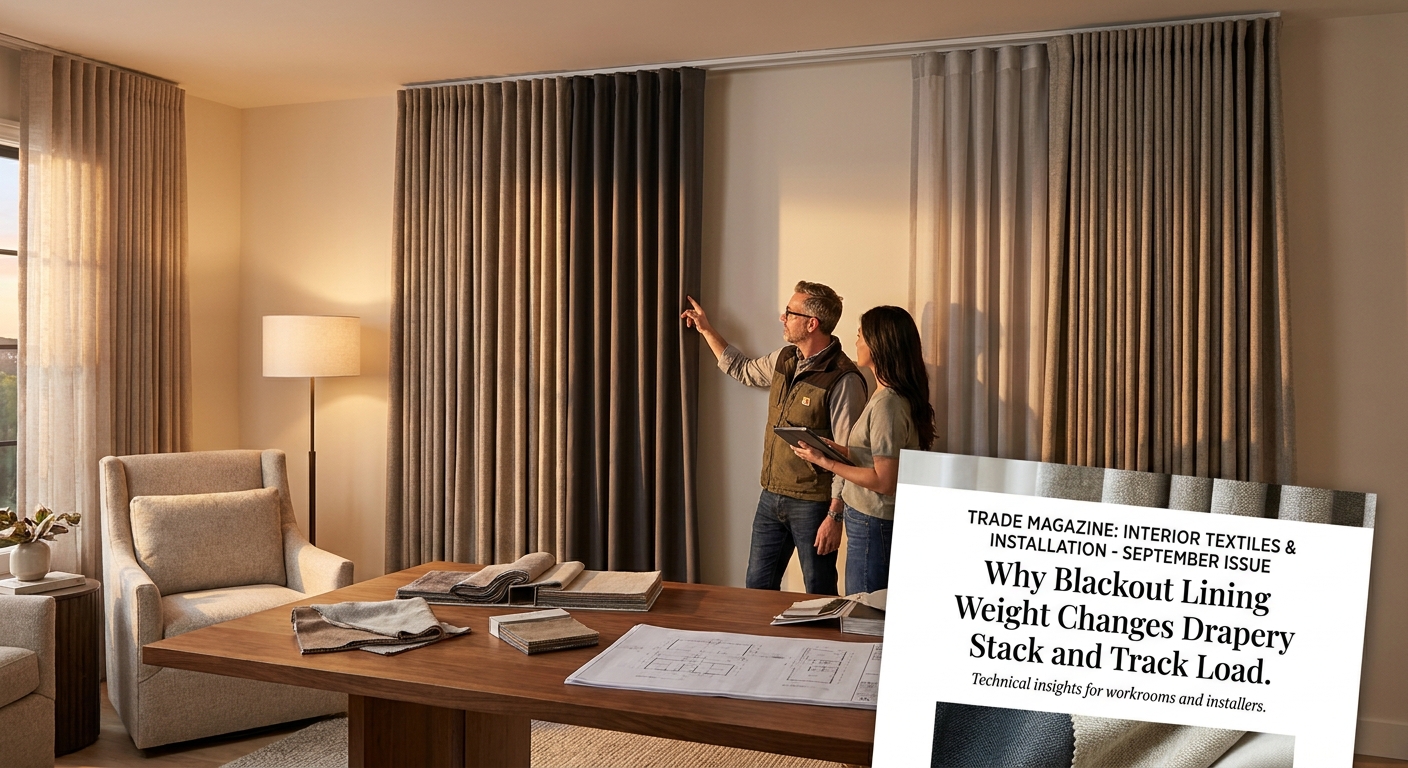
Why blackout lining weight changes drapery stack and track load
When sourcing luxury italian fabrics from Sarelli Textiles for custom window treatments, buyers must account for how the addition of blackout lining alters the physical properties of the drape. While standard unlined curtains hang lightly, attaching a dense coated backing fundamentally changes the structural requirements of the entire window assembly. Buyers must recalculate hardware specifications to prevent track failure and adjust rod widths to accommodate the expanded fabric stack.
How blackout lining increases fabric weight and thickness
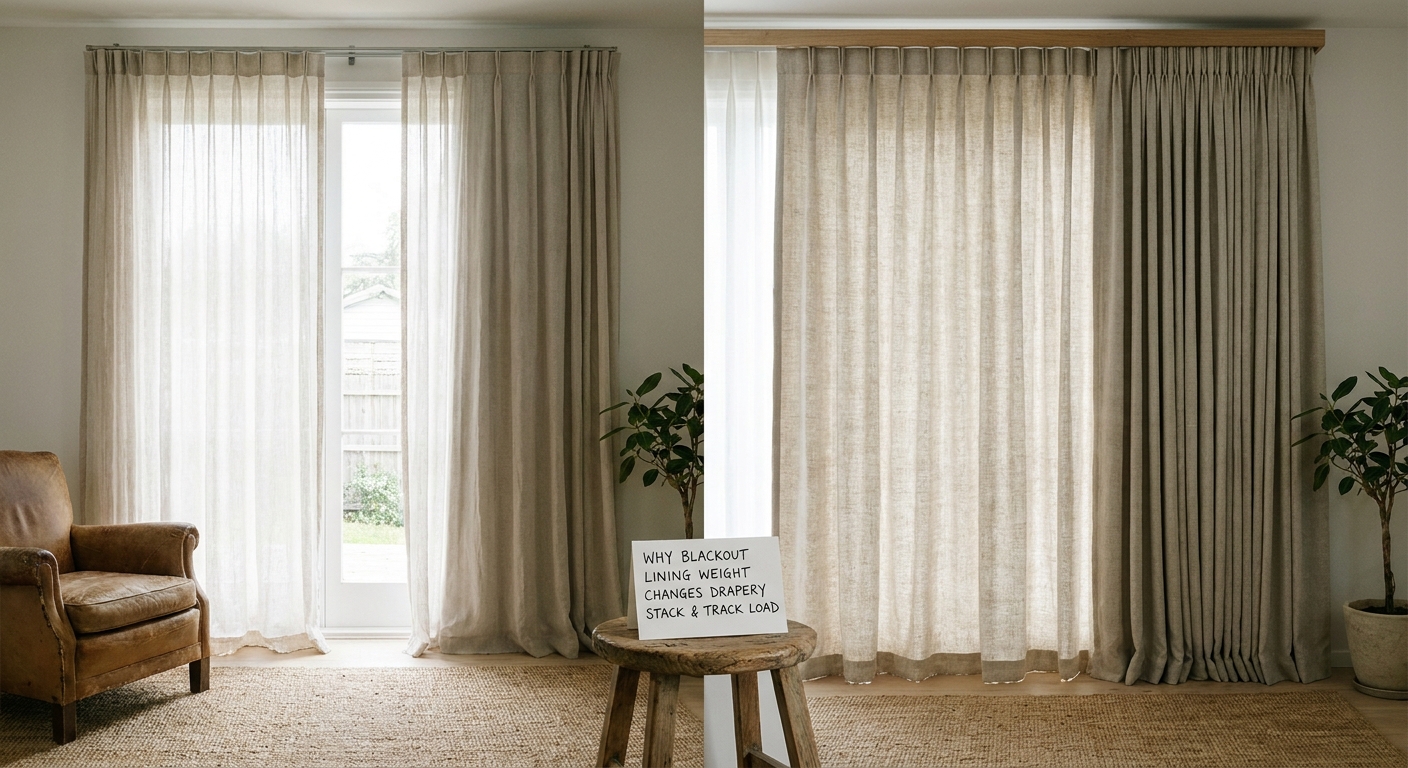
Adding a blackout lining fundamentally changes the physical structure of a curtain by introducing a dense, multi-layered barrier that significantly increases both the overall thickness and the total mass of the window treatment, requiring buyers to recalculate their hardware specifications to accommodate the heavier textile load.
Standard face fabrics typically weigh between 150 and 300 GSM, which is a standard measurement of area density. When a manufacturer adds a 3-pass thermal blackout lining, the lining alone contributes an additional 250 GSM to the drape. Combining a heavy face fabric with a coated lining effectively doubles the weight of the curtain panel. The coating process, which often involves applying layers of acrylic foam or rubber to a polyester base, creates a stiff window covering barrier that resists natural folding.
The impact on drapery stackback dimensions
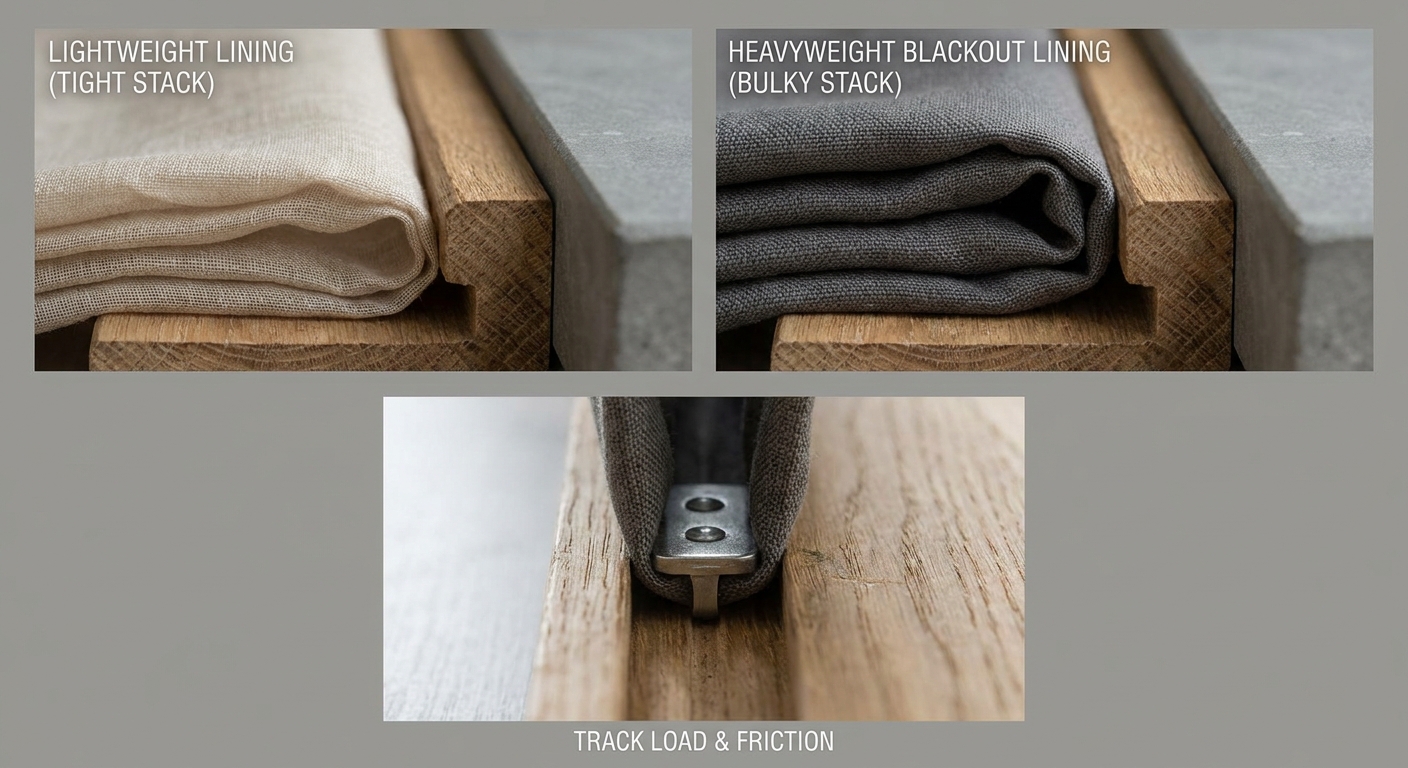
Stackback refers to the amount of wall space a curtain occupies when fully opened. A standard unlined curtain typically requires a stackback equal to roughly 33% of the window width. Because blackout linings add substantial thickness and stiffness, drapery pleats cannot compress as tightly as sheer or unlined fabrics.
Adding a 250 GSM blackout lining increases the required stackback width by 15-20%. To ensure the heavy curtain clears the glass completely and allows maximum daylight into the room, installers must extend the curtain rod 3 to 6 inches further past the window frame on each side. Failing to account for the expanded stackback results in the thick drapery permanently blocking a portion of the window.
Calculating track load capacity for heavy curtains
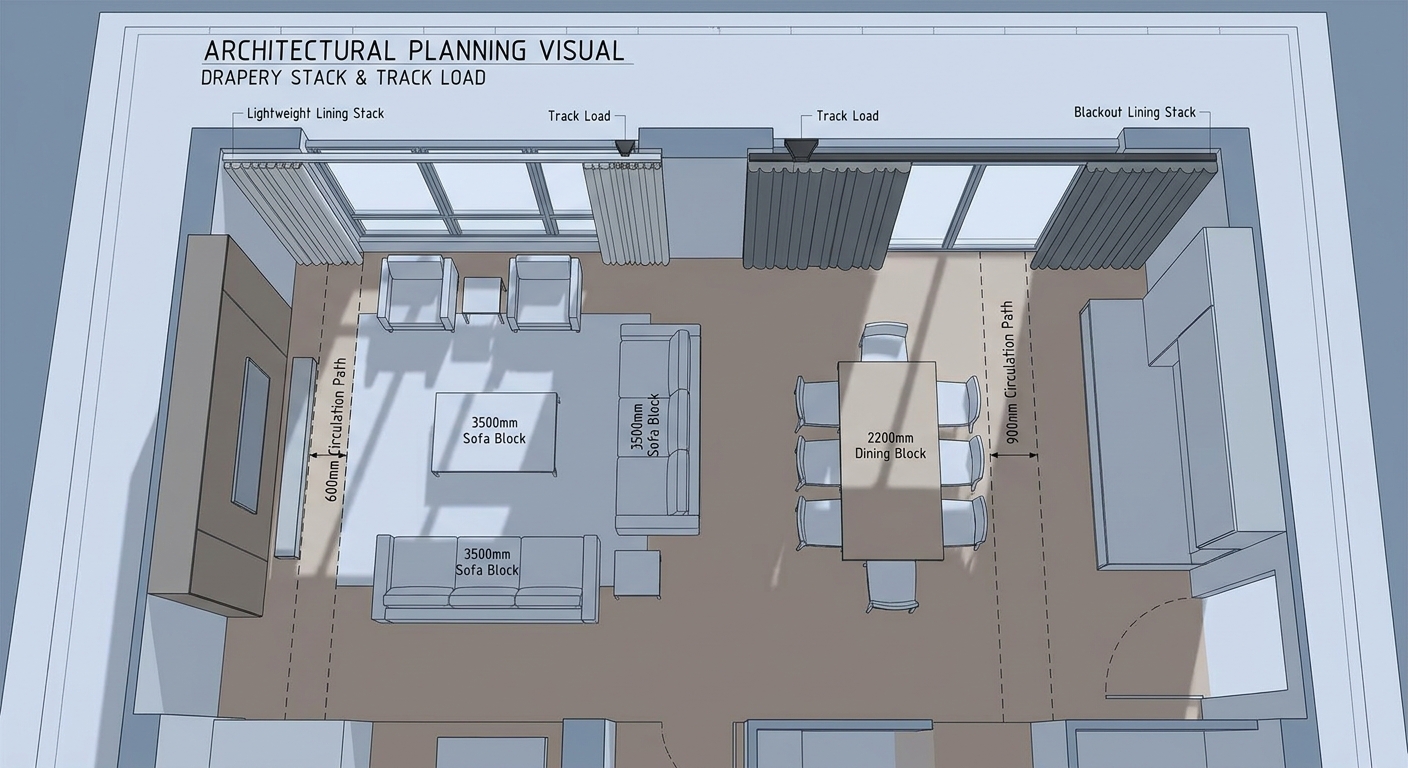
Upgrading to a blackout lining requires installing heavy-duty architectural tracks because the combined mass of the face fabric and the coated backing frequently exceeds the standard weight limits of basic residential hardware, necessitating reinforced brackets and structural wall anchors to prevent the system from failing.
A standard PVC or lightweight aluminum track typically supports a maximum load of 11 to 15 kilograms. However, a wide set of double-width curtains featuring a 300 GSM face fabric and a 250 GSM blackout lining can easily exceed 20 kilograms. Heavy-duty architectural tracks and motorized systems are engineered to support 40 to 60 kilograms, ensuring the hardware does not warp under the constant downward pull of the textiles.
| Fabric Configuration | Estimated Weight | Required Track Capacity | Recommended Hardware |
|---|---|---|---|
| Unlined Sheer Fabric | 50 to 150 GSM | 5 to 10 kilograms | Standard PVC Track |
| Medium Face Fabric (Unlined) | 150 to 300 GSM | 11 to 15 kilograms | Standard Aluminum Track |
| Heavy Face Fabric with 3-Pass Blackout | 450 to 550 GSM | 40 to 60 kilograms | Heavy-Duty Architectural Track |
Managing dynamic forces and shock loading
When a person pulls a heavy curtain closed by hand, the sudden acceleration creates dynamic forces that multiply the effective weight on the track. In theatrical and commercial fly systems, engineers calculate shock loads to prevent hardware failure. For residential window treatments, dynamic forces mean the wall anchors and brackets must be rated for at least twice the static weight of the blackout drapes. Installers should secure the track directly into wall studs or use heavy-duty toggle bolts, spacing the support brackets no more than 16 to 24 inches apart to distribute the load evenly.
Related reading on this site
Readers comparing planning rules can also review Meet Our Team for adjacent context on the same site.
Material and proportion decisions connect closely with About Us, which gives readers another local reference point.